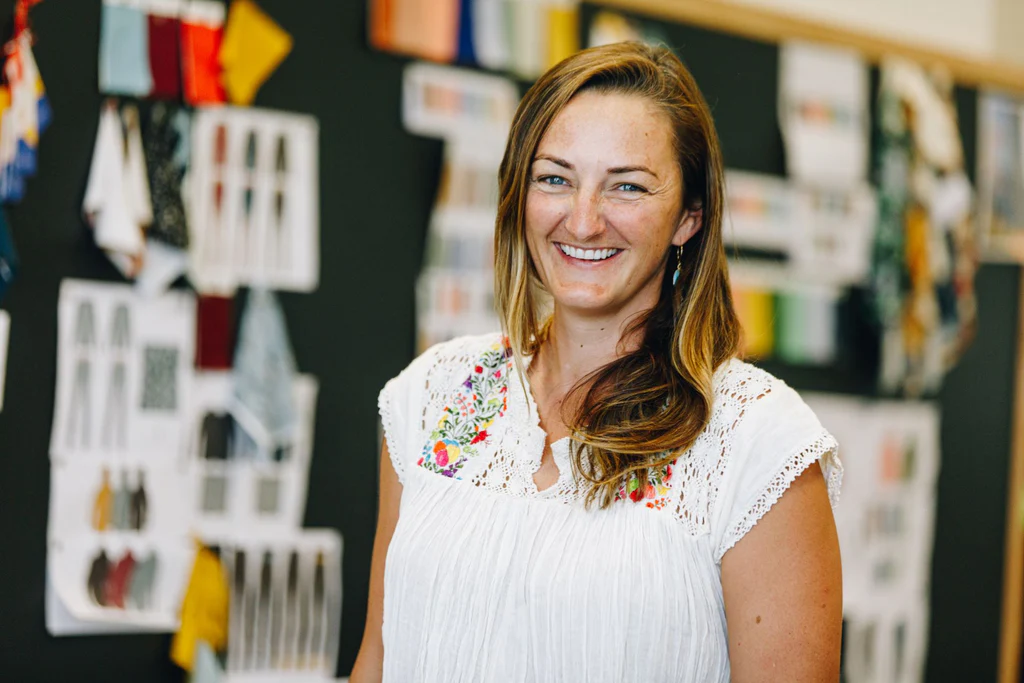
Cassie Abel
Everybody who’s adventure-related loves independent brands. But building one is not easy. There’s a reason the outdoor industry is dominated by the likes of Patagonia and The North Face and its corporate owner, VF Corp: it takes a lot of money and a lot of people to build something up from scratch. But it can be done, and it can be done well. Cassie Abel is the founder of Wild Rye, a women’s outdoor apparel brand that seems to have gone from nowhere to absolutely crushing it. Of course, the journey is never that fast, or that easy.
I’m so excited to have you. I’ve known Cassie for at least a decade, maybe longer, and I know how hard it is to run a small business. From the outside it looks easy, but it’s been a fast seven or so years that Wild Rye has become a really big presence — and an important voice advocating for women in the outdoor space. But it’s probably been the longest seven years of your life. So let’s just jump in. Give us a bit of your backstory and tell us how Wild Rye came about.
I’ll start from the very beginning. I grew up on a rural island outside of Seattle, spent a lot of time playing outside, a lot of time down at the creek. I also played every team sport under the sun — played lacrosse through college. When I graduated, I went straight into investment banking, and very quickly realized that wasn’t for me. But I learned a lot. From there I completely swung the pendulum the other direction and coached lacrosse at Berkeley. Then I found my home in a marketing agency in San Francisco, where I worked on the Visa account, specifically within their food and wine division.
During that time, I spent every weekend driving to Tahoe to get to the mountains. One weekend I spent 13 hours trying to get to Tahoe on a Friday afternoon, sleeping on the side of the highway, because some bozo in a Mazda Miata tried to get over Donner Pass in the middle of a snowstorm and shut down the freeway. So I found I was spending my whole life in a car trying to get to the mountains to be who I’m supposed to be. That’s the longer version of how I ended up back in Sun Valley at Smith Optics, where I was a global communications person — which is how I first met Steve. We worked with AJ for a long time, both on the print and digital side.
And then, a few years into my time at Smith, they announced they were going to relocate to Portland, Oregon. I was handed one of the toughest decisions of my life: between my dream home, where I wanted to be, the lifestyle I wanted — half a mile from the base of the mountain to ski, a couple of blocks from mountain bike trail access — or my dream job. I’d always dreamed of working at Smith, since I was a child. Ultimately, lifestyle won out, and I stayed in Sun Valley. But that brings me to Wild Rye.
During my time at Smith, I attended every single trade show out there, across categories of outdoor sport. And no surprise — this was back in 2011, ’12 — there weren’t many women walking the trade show halls. There definitely wasn’t much innovation on the women’s side when it came to product. There were a few industries where this was a really stark reality, and Interbike was the most drastic view of that. Interbike was in Vegas at the time, and they still had scantily clad booth girls trying to usher more men of the bike industry into brand booths. It felt like there were more booth girls than there were women actually working in the industry. And frankly, the product matched the attention given to women.
So when Smith left the Valley, I reconnected with my now-former business partner. She’d been working at Specialized Bicycle Components, me at Smith, and we were struggling with the same thing. There just wasn’t great product. There wasn’t great storytelling. The outdoor industry, specifically snow and bike, felt really masculine, really intimidating, and just wasn’t a very welcoming place for women.
You live in probably one of the best places in the world to ride mountain bikes. So given your multi-sport background, and given that, as far as I can tell, you’re pretty smart — why in the world did you decide to start an apparel company? That’s a big undertaking. How did you make that leap from “it’s this idea” to “we want to do it, and we want to do it as a bike company”?
We were really naive. We didn’t know what we were getting into. And I have to give a lot of credit to Katie, my now-former business partner. She had a much more fully baked plan and was moving full speed ahead. An old industry friend connected us and basically said, you two are talking about the same frustrations. You want to give women better options. You should chat. You have this great background in marketing, Cassie, and Katie’s not really comfortable in the marketing space. So have at it.
We spoke a few times on the phone — it was before Zoom was really a thing. And it turned out we’d actually known each other from my Bay Area days. Not well, but we’d both attended a wedding in Bermuda and a wedding in Tahoe without really knowing each other at the time. We finally met up in person at the Nordstrom Cafe at Outdoor Retailer in 2015. And I proposed to Katie that she let me be her partner. I completely fell in love with her idea, her take, her approach to better serving women. So in August 2015, we started moving forward together. Katie had put in a few months of work leading up to that point.
Was her idea a women’s bike apparel company? A general women’s apparel company? How did that evolve from that initial meeting to what Wild Rye is today?
It was her idea to have a European-style outdoor brand that was bike-focused in the summer and snow- or ski-focused in the winter. At the time, both of us were skiers more than bikers, but we saw giant holes in the bike industry. You look at The North Face and Arc’teryx and some of the bigger technical brands, and they’re climbing on the summer side with snow in the winter. That’s really where those brands started — in the sports of climbing. Patagonia, too. We really wanted to build our roots in the cycling industry, but equally in the snow industry. So that’s the early days.
Why had so few brands gone into bike? Because bike is huge. Is it because their founders were rooted in climbing, or is there something about bike that’s more challenging to pull off?
Again, this wasn’t a data-driven decision on our part. We were totally naive.
Team naivete.
I like biking more than climbing, so there was a little of that. But the Interbike scene was gross. It was so masculine. I shouldn’t say gross — I’m being a little dramatic — but it wasn’t an approachable place for a woman to come into, even as a founder. So maybe that had something to do with it.
I think gross is a fair assessment. I haven’t been to Interbike in a couple of years, but the booth girls — it’s just so cringey.
Amazing to think it happened at all.
Being a woman in the industry, walking through the halls and having these girls in bikinis trying to usher you into a booth — you’re just like, no thanks.
I’m curious how much of your frustration was rooted in not being able to get the products you wanted, versus just not seeing the representation you wanted in the industry.
Both, equally. Katie and I talked a lot about how product suffered. I have photos of me wearing product that was either sent to me or that I purchased during my Smith days. I’m a tall, very athletic human being — not the skinniest person out there — but I could barely squeeze into extra-large bike shorts, because the bike industry was so tailored toward that extra-extra-extra-small female consumer. So product was a really big issue. Even recently, a couple of months ago, I spoke to the former leader of a major bike brand with an apparel arm, and they told me only 15 percent of their apparel SKUs are women’s. So this is still an issue with major bike brands. They’re still not producing product that’s for women first and foremost.
And women really do need stretchier fabrics, because we have much broader shapes and curves and sizes. We were forced into product that had no stretch, that was built for a man and then adapted — beyond just shrinking and pinking. The material selection wasn’t considered, and materials need to be different for men’s and women’s products.
How so?
Stretch. Having stretch in the right places for a woman’s body, to accommodate often smaller waists and bigger hips and behinds. And the bulk of the quads when you’re exercising, especially in skiing and biking. But back to your original question — the narrative, the way brands were speaking to women, was really alienating too. It was solely focused on winning and being the best. I’ve been pulling out old ads of bike brands over the last couple of months, and there are things like “no shortcuts” — these really bold statements about the right way to be on a bike, and it’s winning, it’s fast, it’s serious. That just didn’t resonate with us as consumers, or with our friends. And then, very infrequently did you see women featured in any of these ads. As an employee who looked at a lot of ads at many brands — Smith was actually one of the better brands about featuring females, but it was still maybe one in six ads focused on women compared to our male athletes.
That’s brutal, given that women make up what, 50.8 percent of the population.
Something like that.
That’s excruciating.
And 46 percent of outdoor participants.
Where I live, I’m not doing surveys, but I feel like I see just as many women on trails as men. Easily, around here too, in Southern California. So who’d have thought women like to get outside too. That’s bonkers. So how much of this did you have to learn on the fly — the fabrics, the patterns? Were you able to bring in experienced people to flatten the learning curve? I know you hit some real brutal speed bumps.
Katie and I had zero apparel experience. We’re not designers, we’re not developers, we hadn’t worked with factories. So we were 100 percent learning on the fly. We did bring in a designer early on, who we found on Craigslist, of all places.
Wow, amazing.
Katie put out a Craigslist ad in Tahoe — she was based in Tahoe, I was based in Sun Valley. And Kelsey, who we found on Craigslist, is still our designer today.
She’s also the only cat owner on your team, isn’t she?
We have two cat owners. The other is our resident cat daddy, our data analyst, Colin. He’s also our only full-time male employee.
Is it a requirement to have dogs with cool names? Because on your About page, every person aside from those two outliers has dogs — multiple dogs, all with very cool names. Is that even legal to require?
I don’t know if there are technical laws about that, but we certainly attract dog lovers. I can’t remember what we were talking about. I think I was about to dive into all the trials and tribulations.
Sorry, we keep interrupting. I told you we were going to have a normal conversation, which means — is there a term for man-interrupting that’s the equivalent of mansplaining? Because that’s what we keep doing.
No, I’m always happy to be interrupted to talk about dogs. But I was about to pull back the curtain on all the gnarly stuff from the early days. So Katie and I are anxiously awaiting our final bulk production run for our big launch of the entire brand. It was already four months late. Finally the product arrives. We had four products in that first run — a baggy short, a chamois short, and two merino tops. Two of those four came in completely flawed. Every single unit in the chamois run had the silicone leg band sewn on inside out, so the silicone was on the exterior of the short rather than the interior to hold your chamois in place. We had to find seamstresses to unsew and resew every single leg band before we could launch. I don’t remember how much that cost, but it was easily ten, twenty thousand dollars. Keep in mind, we hadn’t made a dime. We were completely self-funded — not VC-backed, no angel investors. We were pinching pennies, putting our personal savings into bringing this brand to life. So that was a hugely devastating blow.
Does that happen because you didn’t realize you have to be super specific about telling them where things get sewn on, or do they just screw it up?
In this case, they screwed it up. And they took zero responsibility, because we’re a tiny brand. We’re already begging factories to work with us. We’re not ordering massive quantities. So these factories have no incentive to work with us other than us telling them our story and how big we want to be. From a financial perspective, they don’t give a S-H-I-T about us.
You can say it. They don’t give a flying fuck. I remember when we were trying to figure out our printer for the first time, and we had absolute disasters with our initial printer, and they would not take responsibility. Despite having been in publishing my whole career, I had no idea how to pick a printer. Do I go on Yelp? Is there a Yelp for Chinese factories? You make that commitment, and it must have been really scary. You go through the sampling process, the samples were probably okay because you signed off on them, and then you get your order and you’re so excited, and you open it up. That must have been such a disheartening moment. But you weren’t through it. So how long did that delay you in getting product to customers?
That was one of the product issues. The other was that the waistband on every single one of our baggy shorts was about an inch out of spec — an inch bigger flat than it was supposed to be. So our medium was fitting like a large, our large like an extra-large. That we couldn’t fix, but we needed to figure out how to message it. With the leg band issue, that production landed in July and we were still able to launch in August — four, maybe five months past our initial planned launch date, which was April. So we launched, I believe, August 9th, 2016.
Do you think you had some runway? I’m a big believer — I’m wearing a Filson shirt, which isn’t a small company, but I absolutely go out of my way to support small businesses I believe in. If I ordered something from Nike and it was wrong, I’d be mad and never order again. But with a smaller brand just starting out, there’s more understanding, and I’m stoked for you to succeed, so I’ll put up with some challenges. Do you think people were so excited you were there at all that they were like, we can wait a few months?
Luckily, we hadn’t launched before the leg band issue was discovered, so we just delayed the launch. On the waistband issue, we couldn’t fix it, so we told people if they wanted a medium, they should order a small to fit like a medium. But yeah, I think we definitely got more runway. It depends on the consumer, and how educated they are. Those of us in the outdoor or apparel space understand the nuances a bit more. The general consumer maybe doesn’t always have as much tolerance.
They want their shorts, and they want them cheaper.
So what were your design cues? What were you trying to do differently — your point of differentiation? And because of your marketing backgrounds, how did you communicate that to this new, growing customer base?
We wanted to nail fit, which we didn’t quite do in the first round — though it actually fit really well if you ordered the right size, given the revised messaging. We wanted to fit as many women as possible with a silhouette, which meant gussets and paneling to fit curves. We wanted highly durable, technical product. We didn’t want to create dumbed-down product, which we often saw in the outdoor space — there’s the pinnacle product, but it’s only available in men’s sizes and fit, and then the next tier down is where you start getting a colorway for women. We wanted our pinnacle product to be highly durable and perform really well, but also have a more contemporary look. The outdoor industry is notorious for using the same colors for women, the same paisley or dated floral prints. Don’t get me wrong, I love a good floral — we love florals at Wild Rye — but something hipper and cooler than the average outdoor print and color scheme. So those were our three pillars: beautiful, technical, and well-fitting.
Men want that too. I get so annoyed at most of the color options. I’m usually attracted to the women’s colors more than the men’s, and frustrated I can’t order them in my size.
Just go to OR.
We do have some men wearing our shorts, just saying.
Really?
Yeah.
Cool. I was going to say, just go to OR and count the number of button-up plaid short-sleeve shirts. No shade on those shirts. Well, maybe some shade.
There’s not a lot of white space in that category.
This raises an interesting question about the perceived tension between function and fashion. Historically, with outdoor apparel, “fashion” is a horrible word — it’s perceived as somehow less core, as if somebody doesn’t want to still look good when they’re climbing a peak or going for a trail run. We have to set aside our dignity when we go outdoors and play? That’s ridiculous. There was a Wall Street Journal story last week, the headline was “the gorpcore backlash — why true adventurers are skiing in jeans and hiking in rompers.” There’s a quote from Elliot Wilkinson-Ray, who founded one of the brands they featured, aside from Wild Rye — Ripton — who said there’s a real demand to rebel against the recent intensity. So how does that inform what you do with Wild Rye? Do you think the story’s valid? Is there a backlash against gorpcore? What do people really want from the apparel they play in?
I think there’s definitely a backlash, especially in the younger generations. People don’t want to look like they’re going to climb a mountain even if they are. The overly logoed bike shorts — that was something we rebelled against back in 2015, ’16, when we launched. Historically you were given the options of Fox and Troy Lee and super-moto-looking brands with giant logos. My generation, and definitely generations younger, don’t want to be a walking billboard. And I think the overly logoed look makes the wearer feel like there are certain expectations of how they’re going to perform. Some of us just want to go out for a bike ride with our friends and look good, feel good, eat some snacks, take a couple selfies, get some exercise, catch up on the town gossip. We’re not looking to win a race or summit a first ascent. Having the wardrobe to match the way we’re recreating has become increasingly important.
That’s such a good point. I don’t even own a road bike, but I have some full bibs. In the summer when it’s super hot, I’ll do a gravel ride and wear that with a synthetic top, and that’s the only time I’m really ever wearing visible spandex — and I feel like I have to pass everybody. Something about it, now I feel like I’m in a race. But the rest of the time, I’m a big Ripton fan. I ride in almost nothing but jorts.
You’ve started wearing shirts when you ride now.
Yes. I’ve also classically enjoyed riding without a shirt. But the reactions you get from other people on the trail — it’s a much more “hey, what’s going on” vibe if you’re in a long-sleeve cotton or wool shirt and jorts versus a full spandex kit. The whole mindset’s different.
Interestingly, when I put on a pair of bibs — actually I don’t know if I have any bibs anymore — they’re just so purpose-built. I don’t necessarily feel like I’m going to go faster, but I feel like I’m wearing just what I need to be wearing for a long ride. Whereas with baggies, I feel better getting off the bike, but I don’t necessarily feel better on it. It’s funny to consider these psychological factors. And even those of us who are older didn’t necessarily want a big Fox logo. There are associations with brands you don’t want to be part of — nothing to do with Fox — but when there’s a big logo, you’re representing, even if you don’t want to.
And I think choice is the most important thing. We certainly make spandex, because it’s purpose-built for being on the bike. We have bib shorts — a lot of women wear those underneath their baggy shorts, because it holds you in in all the right places, and we have a really nice Italian-sourced women’s-specific chamois pad. Those are very important pieces in your bike collection. But the element of choice, of not being forced into being a walking billboard or into spandex being your only option — that’s where that article was going. The product featured by Wild Rye in that Wall Street Journal article was a pair of technical overalls, which I love, but I don’t necessarily like to wear them on my bike. I’m a little more old school and still wear bike shorts on my bike. But they’re a cleaner look, not as in-your-face as some of the logoed options, and they fit.
It’s funny — for so long people were buying North Face and Patagonia because they wanted to look like they were outdoors, and now you’re getting a flip to the opposite.
I don’t know that it’s fully going away. Just adding more options for those of us who do want to get after it.
So how many SKUs does Wild Rye have now? You started with four.
I think we’re around 40, plus accessories.
Do you have a limit? Down the road, do you say we don’t want more than 100, or 50? How do you keep from mushrooming into endless SKUs?
As our new fractional CFO just said, SKUs kill. Don’t go there. Our goal is to be the women’s outdoor brand of choice across categories of outdoor sport, so that will mean more SKUs and growth into new categories. But we want to be really thoughtful. We’re sunsetting styles as we add new ones, keeping things fresh, evolving our existing silhouettes. We also do a lot of work with color and print to keep it fresh, rather than trying to out-tech everything, which became a thing in the outdoor industry. Walking through Outdoor Retailer, every booth had some new technology and you’re like, what does this really do? Do I really need this? Let’s just out-tech each other to get the media attention. We’ve got great technology and we don’t need to be one-upping ourselves and everyone else every year.
That’s a tricky one, because it makes me so sad when I have a product I love and then you can’t get it anymore because they had to come up with something new, or your favorite color is gone. I get it — it’s competition, and human nature wants new things. But when you nail a product, I think you should keep it as long as you possibly can.
Our Freel bike short has been in the line since 2017 with very minimal changes. I think we changed the shape of the hem divot on the side just to contemporize it, but otherwise the fit and fabric are the same, other than evolving colorways. Still our hero product.
Amen for hero products. Let’s talk about the name — we forgot to do that. Where does Wild Rye come from?
That was another of our mishap stories from the early days. We launched under a different name. And within a week of launch, we had a cease-and-desist order in our inbox from a major brand. It was probably the kindest cease-and-desist we could have gotten as a small brand, so I have no qualms with that company. But we had about a week to change our name before we had to submit our trims for the next season. So Katie and I had to sit down, scour the internet and Wikipedia for peak names, river names, flora and fauna, and think about what would represent the brand. We landed on Wild Rye, because it’s a grass that grows at elevation, much like we like to play. It’s wild, it’s enduring, it’s free-flowing and free-spirited, like us. And it sounds good.
It’s a great name.
And it wasn’t taken.
Just so you know, I got one of those — I didn’t get the letter, I got the call, in the earlier iteration of Adventure Journal when it first started. And Rivian, the electric vehicle company — same kind of thing. They were launching and got the knock-knock, we’re lawyers. I think they made up a word. They were near the Indian River in Florida, I think, where they were based. And we just launched Long Weekend Coffee this year, and Justin was part of the brainstorming around the naming. You think you’ve got a couple of really good names, and then you go to the US Patent Office trademark search, and the state, and you look for URLs and social handles, and you start to understand why there are so many nonsense names out there for companies.
Yeah, finding the right levels of how things are taken is mind-blowing.
Wild Rye so perfectly represents what you’re doing. It’s very evocative, but still broad enough that you can apply your own values.
It’s a much better name. Everything happens for a reason. All the product mishaps happened for a reason — we learned a lot, we know how to communicate better with factories now. I love our name. I feel grateful to the powers that be that made us change it.
Let’s talk about values. Wild Rye is a B Corp. You’re a member of 1% for the Planet. You’re certified climate neutral. Those are huge commitments. And as I’ve learned over the years, you come in with this idea of doing best practices across the board, and then the market and your margins often tell you something else. So what’s been most important to you — within those certifications or otherwise — and where do you live your values through the brand?
To me, our number one value is serving the needs of women. Women in the outdoors, fellow women in business, women as human beings. I’ve always viewed the sustainability part as just expected. It’s not something we toot our horn about a lot — it’s what I believe should be baseline for every brand in the outdoor industry. On the certification side, I’m still feeling my way through which combination is best for us, what we should hang our hat on. Unwaveringly, we are B Corp certified — socially driven, sustainably driven, people-driven. When it comes to climate neutral and 1% for the Planet, I think they’re amazing, but they’re really expensive. And we have other priorities in addition to the environment. As a small brand, allocating resources in the most impactful way is something we think about a lot. For example, in the wake of Roe v. Wade being overturned, we raised about $20,000 for Planned Parenthood and local abortion funds and women’s reproductive healthcare services — that doesn’t fall under 1% for the Planet and didn’t contribute to our climate neutrality. That was a tough year to figure out how to stay 1% for the Planet certified and give a huge chunk to these women’s organizations. So they may not all be right for us in the long term. For now, they’re important, and we’ll do what we can to stick with it. But there are other ways to do the same thing that don’t cost as much.
People don’t realize from the outside just how expensive those things are. And a certain amount goes to just sustaining those operations, which do really great things. We were a member of both 1% for the Planet and Climate Neutral. And especially when we launched in print, our profit went down and our gross went up — and it’s based on gross. All of a sudden I’m facing this massive bill commitment to 1%. I’ve talked to a lot of smaller brands who say, I’d love to be part of it, but my money can only go so far and I want to do these other things that are important to me. So if you’re not in the industry, these certifications and organizations are great, but that’s not the be-all and end-all of the story.
We’ve started exploring other things and gotten creative. We work with a website plug-in called EcoCart, which lets our customers offset their own carbon emissions, and we contribute as well, but it’s not as high-stakes a requirement. It’s been a great resource for a small business. We’ve also launched a peer-to-peer reselling platform through an organization called Treet, which has made it really easy for small businesses to participate in the secondhand market. There are so many other things a small brand can do to be gentler on the planet that don’t come with big price tags or big branding.
Where do you see the values in your product?
From a sustainability standpoint?
Not necessarily — whatever values. I know you’ve tried to work with Bluesign in the past. Those are externally focused, but I know you’re really committed to better serving women, and to the environmental side within the product itself, which is maybe more tangible to a customer.
Inclusivity, when it comes to sizing, has been wildly important from day one. It wasn’t always accessible for us as a smaller brand. A great example: when we were finally in a position to grow our SKU count to add sizes 14, 16, and 18 in our base layers, our factory downright refused to make those sizes. We already have more sizes than your average outdoor brand, because we run numeric sizing, which lets us fit women between a medium and a large — I’m a perfect example. So we ended up sourcing a whole new factory and completely redeveloping the product to offer them.
The factory just wouldn’t make the full size run? They said no?
Yeah. We develop our patterns from the ground up, but we just weren’t producing the volume they needed. They said it’s too much money, too much time, we’ve got bigger clients to worry about. We’re still a really small brand, so trying to negotiate with a factory when we’re not moving big volume…
I remember being at OR a few years back, talking to a rep from a really big brand — I won’t name them — and she was showing me some women’s pants that were coming out. My wife is six-three. We wear basically the same size in tops, but she has longer legs than me, and it’s a huge problem finding pants that fit. I asked the rep what the size limit was, and there was just no chance of them making bigger pants. Even with their numbers, they have trouble getting inclusive sizing made at a cost they can swallow. So I imagine the big brands suffer from that too — there are probably brands that would like to make more stuff in bigger sizes, but…
We definitely eat margins on it. It’s a values commitment over a profit commitment. We’re losing margin on our outlier sizes, for sure. We created a short specifically in size 14 through 24, and the margins on those are paper-thin. But we believe so firmly in getting more women into the outdoors and giving them the apparel to help them feel confident — which means fit, and function.
I realize you’re focused on the women’s side, but I have some stuff from Curious Creatures — I’m assuming you know them. They do something cool: not really unisex, but leaning that direction. The shorts I have from them, I had to convert sizing, because they only do numerical sizes, which I thought was great. Men’s sizes are numerical, sort of. But for the most part, I’m a tall, skinny guy, so I have issues with between medium and large all the time. It was kind of cool to be like, oh, I think I’m a 12 in women’s. I had to do the calculation. And I thought, why isn’t this the case for everything? I love European shoe sizing — it’s so easy. I don’t know why clothes can’t be like that. I’m not suggesting you do this, but does the idea of doing unisex or non-gender-specific apparel ever enter the equation?
We definitely have men who wear our shorts. They’re not a perfect fit — proportions are different. At this point, I think there’s a really great place for non-gendered apparel, no question. Right now, as a brand, we’re trying to fill that women’s-specific need that’s been underrepresented. I don’t want that to be skipped over too quickly. I feel like issues get skipped over so fast — oh, that’s an issue, we need to get more women on board seats, okay, just kidding, moving on to the next thing. I don’t want to get caught up in that. Not to say there isn’t a future for it, or that we don’t have apparel that can be worn by any gender. We’re gender inclusive.
Justin, women have been forced to wear men’s clothes, so you can suck it up and wear it.
I do, I do.
I know you do. But it’s funny, you get the opposite problem — not that it’s really a problem — where I love a colorway and I can’t get it in my size, because it’s on a women’s line. So invariably when I go to OR and fall in love with a pair of hiking shoes, it’s always women’s. And I have such a narrow foot, I should just get them. Joni, my wife, and I talk about this all the time. Different pressures and expectations around dress for men and women, but you have so many more choices. What do we have? Shirts and pants.
You can wear a hiking skirt.
Until you get into technical apparel.
I was considering a kilt for a while, but there aren’t really good options for technical kilts. There’s Utilikilts, but then you look like a Scottish plumber. There’s a DHL delivery driver in my town who’s incredible — I’ve actually thought about ordering something from DHL specifically so he’ll deliver it. He wears this incredible black kilt and giant combat boots. He looks like he’s going to finish his shift and go play bass for a death metal band. I always see this guy in his kilt and think, that’s probably so comfortable.
So you mentioned new categories, and I know you’re looking at growth. We were chatting earlier — you’re in fundraising mode. Tell us about that. I’ve always bootstrapped AJ. We’ve never had any infusion of capital, and that would scare the bejesus out of me. So how’s it going? What’s it like?
I’ve chatted with many founders — once you get on the fundraising hamster wheel, you’re on it forever. So I’m on it. We’re fundraising to expand our product line. Our mission is to be the women’s outdoor brand of choice across categories of outdoor sport. I don’t want to directly reference other brands, but think Patagonia, just focused on the women’s side. So we’re fundraising for that growth. I’ve tapped out my ability to self-fund. Producing apparel is wildly expensive. My house is fully leveraged. I’m lucky to own a house, to be able to leverage it and get a line of credit, but I can’t personally guarantee beyond where we are now.
When you’re soliciting outside funds, is there a point where you’re walking a tightrope between that and your values starting to shift? Do new voices coming into your business start to play in?
I was really conscious to become B Corp certified before starting to fundraise for the first time, because I wanted to point to that logo and tell an investor, if you don’t align with our values, you’re not a fit. We’ve been really lucky to bring on investors who understand B Corp, or are willing to, and understand that being socially, environmentally, and people-focused is a really important part of our brand, in addition to bringing in good profits. I’d love to have a majority-female cap table. We have a lot of women on our cap table, and that’s rare, given that the VC and finance landscape is predominantly male.
Are there special challenges as a woman-led, woman-owned business? Money is amoral and agender. As you look for partners, are you looking specifically for women who can help? And if you’re looking at men too, how does that affect how you think about the brand? Does taking money change or dilute it, or can you find partners who are fully supportive?
It’s values-aligned people, first and foremost. I’d love to have as many women be part of this journey, and I think women are naturally drawn to what we’re doing because we serve women. The men who’ve come on are forward-thinking, or have a woman in their life who’s active and outdoorsy and frustrated in the same way I’ve been. And we have a few men on our cap table who are just really good business people and understand that women control 85 percent of discretionary spending. It’s just good business to invest in brands that serve women.
But women are woefully underrepresented in the outdoor space.
In this fundraising effort, I started digging deep for statistics. My pitch opens with some really poignant stats: women are 46 percent of outdoor participants, but only at the helm of 16 percent of outdoor brands and 4 percent of cycling brands. So the ultimate decision-maker at all these outdoor and cycling brands is a man. When a product or a program is on the chopping block and gets brought all the way up the line, that ultimate decision-maker is a man.
That’s astounding. Not surprising that women’s stuff is the first to get cut when men are making the decisions. On your Women-Led Wednesday website, you had a statistic that blew me away: for Standard & Poor’s companies — really big ones — women are only 25 percent of executive and senior-level positions, 20 percent of board seats, and 6 percent of CEOs, which mirrors what you’re seeing in the bike industry. And in 2015, there were more CEOs of S&P companies named John than there were women of any name at all.
That stat’s been updated since. I think it’s now James and Mark — more James and Marks than women of any name. Or there are more CEOs named Bob than women. It’s mind-blowing.
That’s why I named my daughters James and Mark, because I read that same study. They’ll be CEOs any day now.
I’m also cribbing from your notes. In 2015, McKinsey & Company found that businesses that were more gender diverse outperformed non-gender-diverse businesses by about 15 percent. Five years later, in 2020, that had increased to 25 percent. So gender diversity makes businesses better — we know it intuitively, but now we know it empirically.
Definitely. Those stats are the reason for starting Women-Led Wednesday. The hot-button issue was, how do we get more women into C-suites and onto Fortune 500 boards? That was all the buzz around 2018. And yet we weren’t doing anything at the consumer level to support brands already led by women — bringing these women-led brands up the ranks, because brands led by women are going to bring other women up with them, giving them the tools and experience to move into leadership at bigger companies, or to grow their own brand.
A question from Team Naive — I’ve never started a business. You have the stated goal of being a tentpole women’s company. But is there an avenue for Wild Rye to just cruise along making really good women’s mountain bike products and not expanding a ton? Could you be successful as a pretty small business without that broader aim?
I’m sure we could. I have bigger dreams than that. I just believe women deserve a brand that’s exclusively for us — that tells our stories, promotes our female athletes exclusively, thinks about us first and foremost across all categories of sport.
Look how many companies there are just for men. It’s ridiculous. You talk about Women-Led Wednesday — as I understand it, there was no dedicated shopping day around women’s. There was Black Friday, Cyber Monday, but nothing your brand could get involved with. So you’re the instigator behind this. One of the things you talk about is the idea of customers supporting brands because of what they represent. And as we both found out, the marketplace is Darwinian in the extreme — people vote with their dollars. I’m curious what you see in terms of values-based shopping, and how important that is to your customers. We talk a lot about that with AJ — hey, we’re independent media — but I don’t know that when people come to spend, it really matters to them. So does it matter to Wild Rye customers?
I think it does. Having a voice that reflects our customer has been really important. A perfect example was when we launched the benefit tee in support of Planned Parenthood in the wake of Roe. I remember being terrified to press send on that newsletter. I had a feeling our customer would react favorably, but I didn’t know for sure. That initiative solidified our customer’s values in our own mind. We know very clearly that our customer cares about shopping a brand that stands up for the things they believe in, and for their right to bodily autonomy, and that gives a voice to women.
Very cool. We’re going to wrap it up. Thank you so much, Cassie. Anything we’ve overlooked? Cassie, Justin?
I’m just excited to try on some of these Wild Rye shorts, if there are other dudes out there doing it.
Let’s get you some.
I’m so jazzed. I hope this doesn’t sound patronizing — I’m so proud of you. I can’t even imagine the kind of leverage you have to take on to pay for fabric, to make these commitments. Just a few years ago, I think about your time at Smith and how we knew each other, and to go from that to this. We’re nowhere near as capital-intensive at AJ as what you’ve built with Wild Rye, and we’re still struggling on a daily basis to convince people why $20 for a magazine is a good value. It’s just hard. So to have known you for so long and see what you’ve built, and how passionate you are about it — I’m really inspired by it. There are a lot of businesses that are just about the bottom line, and that’s so clearly never been what you or Wild Rye are about. It’s going to be rad to see where you go as you get this funding and move to the next level of your vision.
Thank you. It’s so great to have an amazing support system industry-wide. I feel really fortunate to be surrounded by people like you. When we launched, we weren’t sure how the industry would receive us, because we were trying to turn it on its head a little — call the industry out and push it to do better for women, which I think we’ve done. A lot of brands have really improved in the last seven, eight years, which is exactly what we want to see.
And I’m personally encouraged to see that you now hire cat people, because animal diversity also makes for companies that are better in business. Just for what that’s worth.
We have Whiskey, Tango, and Foxtrot. They live in Seattle, and Dusty lives in Encinitas — not far from you.
Our backbone is Amy Wong, our calico. She runs this place. Justin’s household is still pet-free, but with two little girls, it’s only a matter of time.
No, I’ll have to move to another house if that happens. Every day I wake up praying it’s not the day the girls ask for the dog, because I’m violently allergic to any animal with hair. But I have a tent in the backyard — I can move out there. Or I’ll just end up wearing some kind of scooping mask in my house all the time.
Photo courtesy Cassie Abel