Just Don’t Call It Glamping
A wave of new lodging properties is catering to outdoor enthusiasts—newbies and hardcores alike
When Cale Genenbacher and his wife were in the military—he a West Point graduate, she a pilot—they were often on opposite deployment cycles, and he spent a lot of time alone, chasing his newfound passions for kayaking, trail running, rock climbing, and cycling, driving three to four hours from his base in search of adventure.
“I was an infantry man, so I slept on the ground for a living all week and didn’t necessarily want to do that on the weekend,” he said. “I was looking for the comfort of a hotel, but also the campfire experience with people. And as I would travel, I would do the same thing every weekend. I’d get on Google and I’d find myself either staying forty-five minutes away at a Holiday Inn or a crappy mom-and-pop motel or trying to convince myself that I wanted to camp at the state park. And all the while, everyone I ever talked to was like, yeah, it’s such a bummer, there’s no good places around. I’d meet so many cool people, whether it be on the hill or around the fire, but at the end of the day, everyone’s gone, right? Sleeping in their cars or whatever.”
Genenbacher left the Army, went to business school, got a job at Microsoft in the Pacific Northwest, and quickly realized a desk job was a direct path to unhappiness. His hunger for a friendly, clean, easy, outdoorsy place to stay had never gone away, though, and with hope and a dream and some advisors and a Kickstarter campaign and the full support of his wife, he made the leap and bought a junky old motel in Westport, Washington, and started turning it into a fun, low-key, hip place for cold-water surfers to stay instead of jetting back to Seattle. That motel was the first LOGE Camp.

Today, in early 2024, there are eight LOGE Camp properties across the United States, with plans for twenty by the end of the year. LOGE is joined by Field Station, owned by Auto Camp and launched in Moab, Utah, in 2023, and Snow Peak Campfield, opening in 2024 in Long Beach, Washington. While there have always been campgrounds, motels, and lodges catering to an outdoorsy crowd, these three brands are at the forefront of a new hospitality experience designed specifically for people passionate about outdoor adventure sports: climbers, hikers, mountain bikers, surfers, skiers, and snowboarders. They are design-centric, reasonably priced, unfussy, and accessorized with the accouterments of an adventurous life. They are connected and open to their local communities. They have coffee, fire pits, and beer. Just don’t…you know…use the g-word.
LOGE Camp: Make It Easy
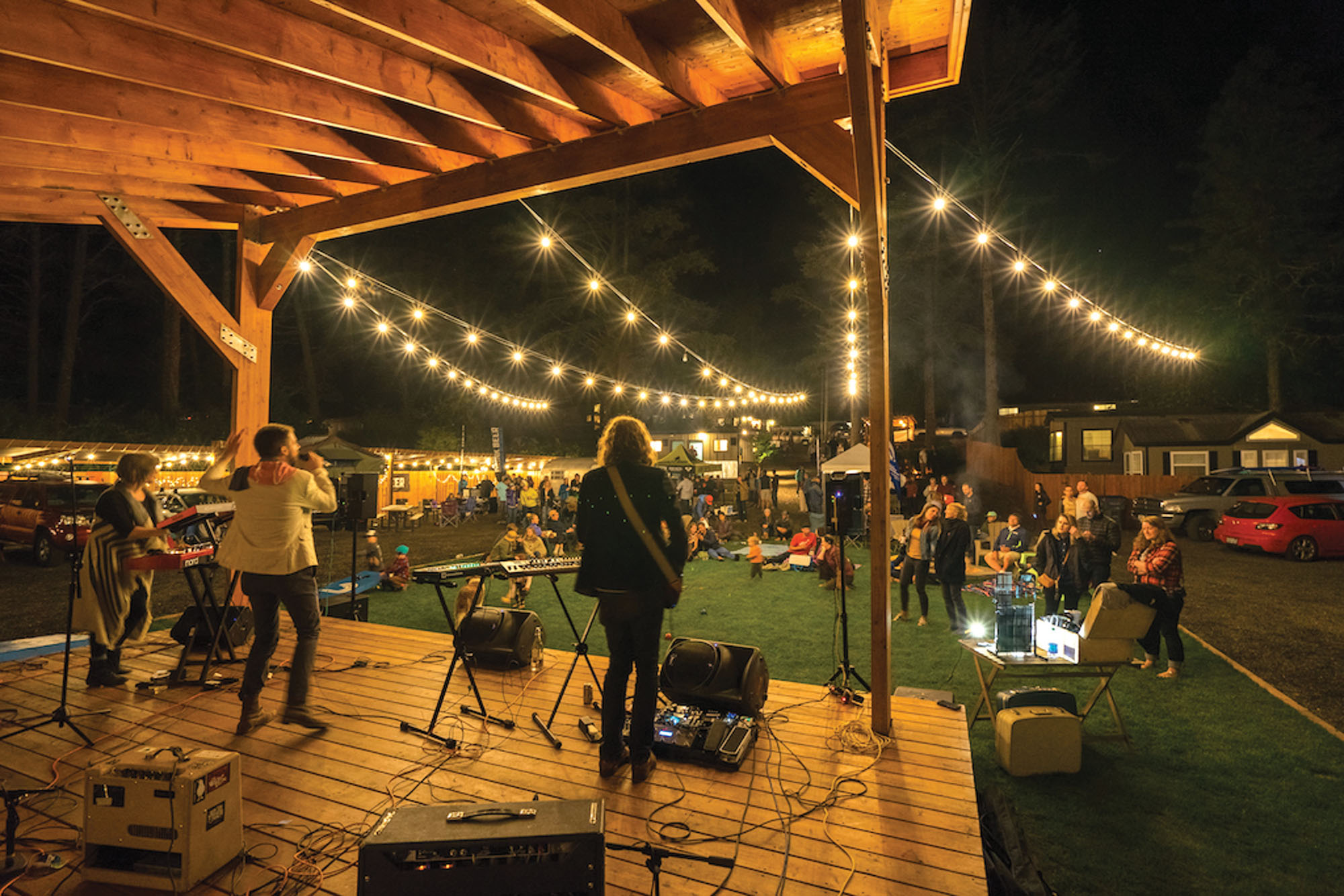
Since launching in 2016, LOGE has continued its approach of buying run-down midcentury motels in locations with close access to public lands and waters, redeveloping them with an eye toward community, and spec’ing them with a who’s who list of cool outdoor gear brands. The property in Bend, Oregon, for example, has bike racks and swinging hammocks in its rooms. There are barbeque grills in front of each room, the better to bring people together. You can rent high-end, full-suspension mountain bikes or borrow townie bikes for free. Friday nights are movie nights, Saturdays are for live music. The lobby has coffee, card games, puzzles, sofas, and comfy chairs, all to spark connection. Rooms are accessorized with Rumpl blankets, YETI water bottles, and more—if you need something, take it and it’ll be added to your bill.
“A key piece of LOGE was that someone’s got to make this easy,” said Genenbacher. “It is too hard all the time looking up gear to rent and coffee shops to go to and what trail’s busy and what’s not, and where do I stay and what guide services suck and which ones are reputable. I was spending so much time planning my trips. I thought, someone has got to make this easy. It’s got to be easier at the end of a long week to get outside, to meet people, to have an adventure.
“Our purpose with LOGE is that we help people find their place by making it easy to connect, get out, and explore. And that all just comes from me being new to these things as an adult or in college and then wanting an experience in my backyard, but not wanting to spend every waking minute planning these trips. I want to show up when I have the time and I want to get after it.”
None of LOGE’s properties are located in marquee mountain towns, like Jackson or Crested Butte. Rather, they fall into the if you know, you know category. Like Wolf Creek, Colorado, which opened in 2023. Or Southport, Maine, opening in 2024. Or Mount Shasta, a criminally overlooked playground in far Northern California.
“The most fun places are the places outside our back door,” said Genenbacher. “And maybe it’s just because I’m a blue-collar kid from Illinois. I don’t love prestige or the idea of prestige. And so I love all these regional places that are under the radar that people turn their noses up at. But it’s where a lot of people go to have fun outdoors, experts and non-experts alike. And so I love the idea of helping people rediscover their backyard. It doesn’t have to be around the world or even around the country for it to be epic. A lot of times the most epic thing is the thing you actually do, and those are in your backyard.”
Field Station: Educating, Gently
Field Station came about because AutoCamp was too successful. The small chain of Airstream trailer camps, which began in Santa Barbara, California, then opened north on the Russian River followed by five other locations across the United States, blew up after covid shelter-in-place restrictions were lifted in June 2020. You’d think a lodging property would want one hundred percent occupancy, but it’s exhausting for the staff and hard on the rooms. Raising the rates barely slowed reservations.
“We looked at our prices and felt really bad about them,” said Taylor Davis, AutoCamp’s longtime vice president of brand marketing. “We never got into the business of outdoor hospitality to price people out of the outdoors. So with that in mind, how do we cater to a larger group of people from an accessibility, inclusivity standpoint? That was the birth of Field Station—how can we create something at a much lower price point that still gave an amazing level of hospitality and service, but catered to a wider swath of the outdoor spectrum from amateurs to adrenaline junkies?”
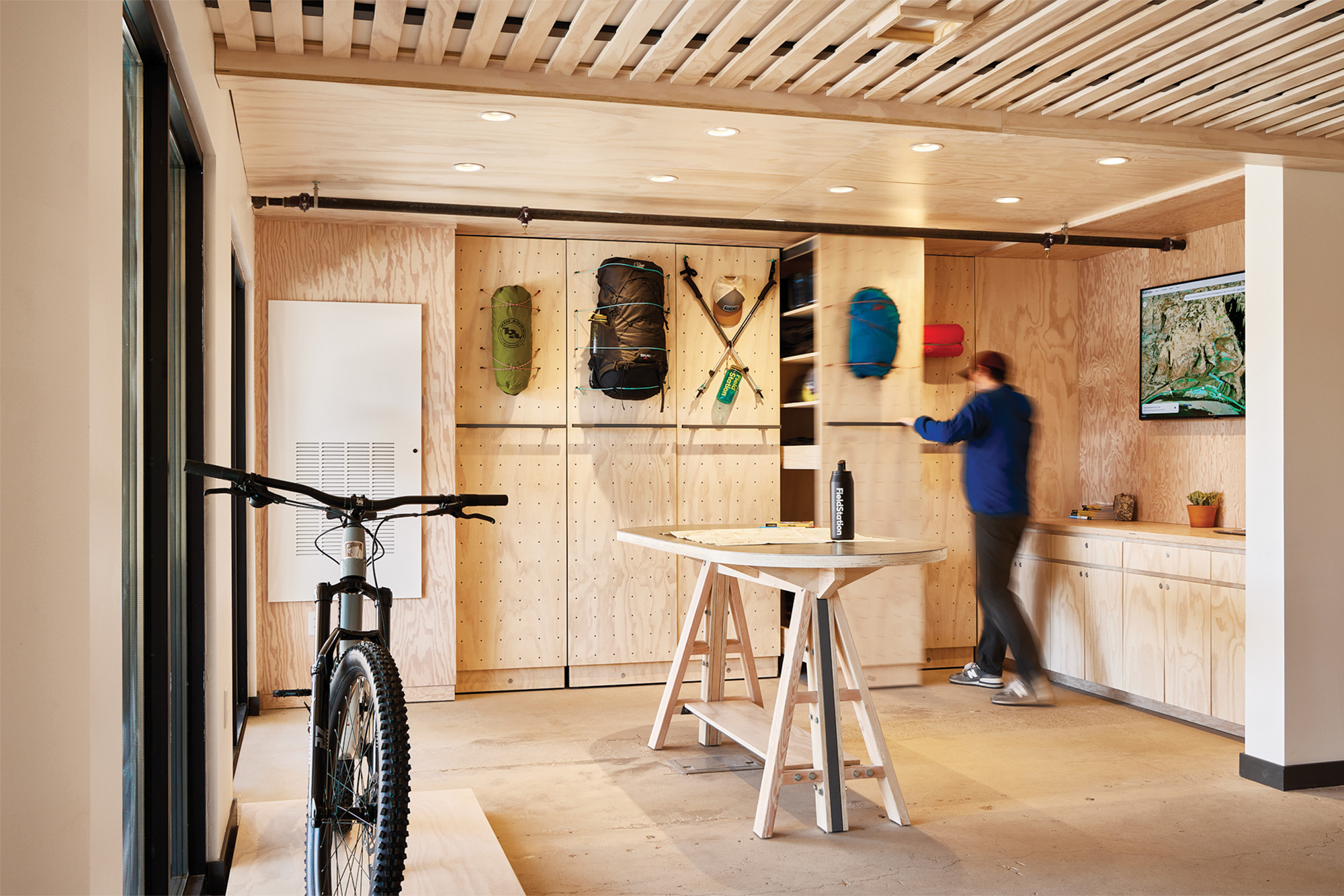
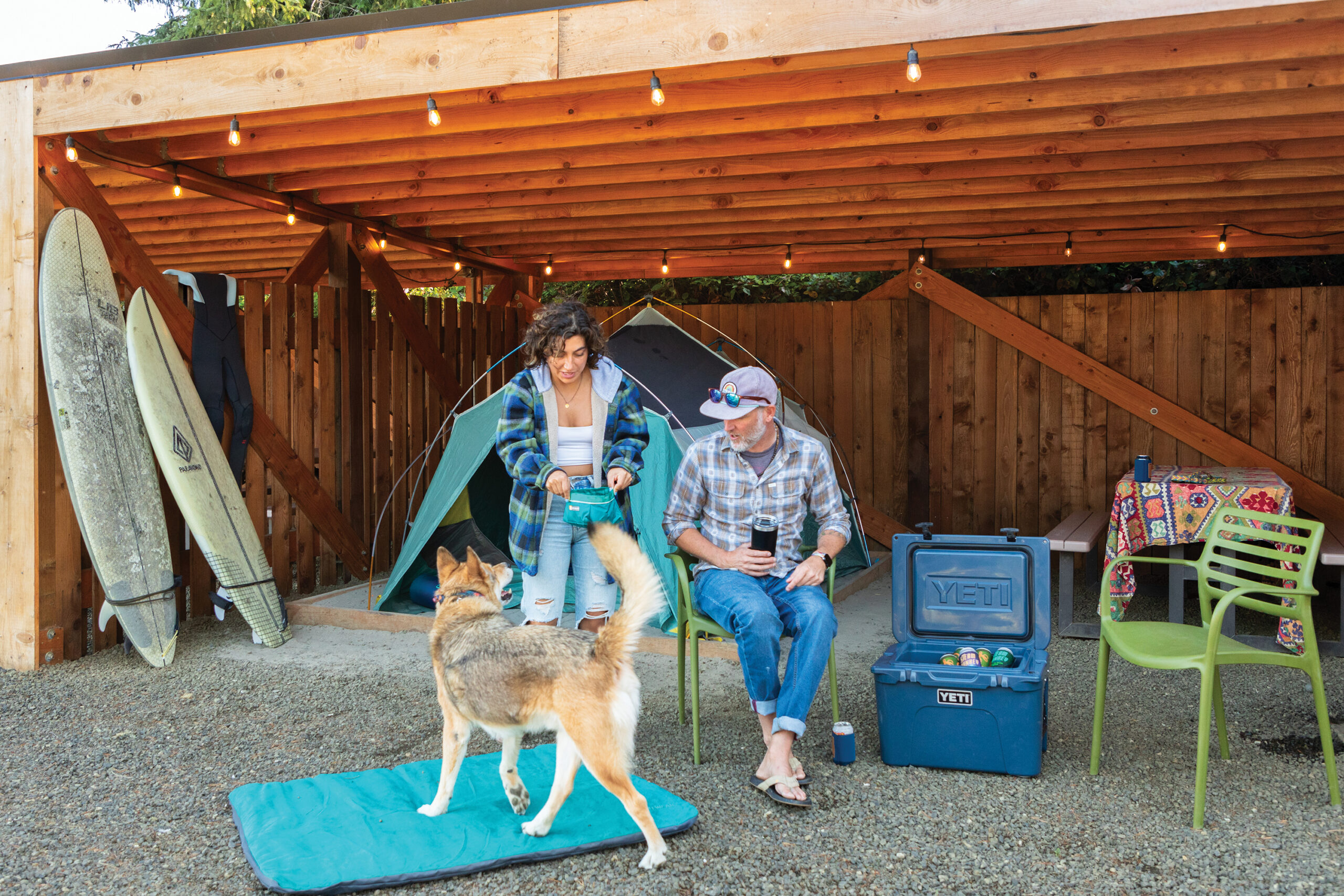
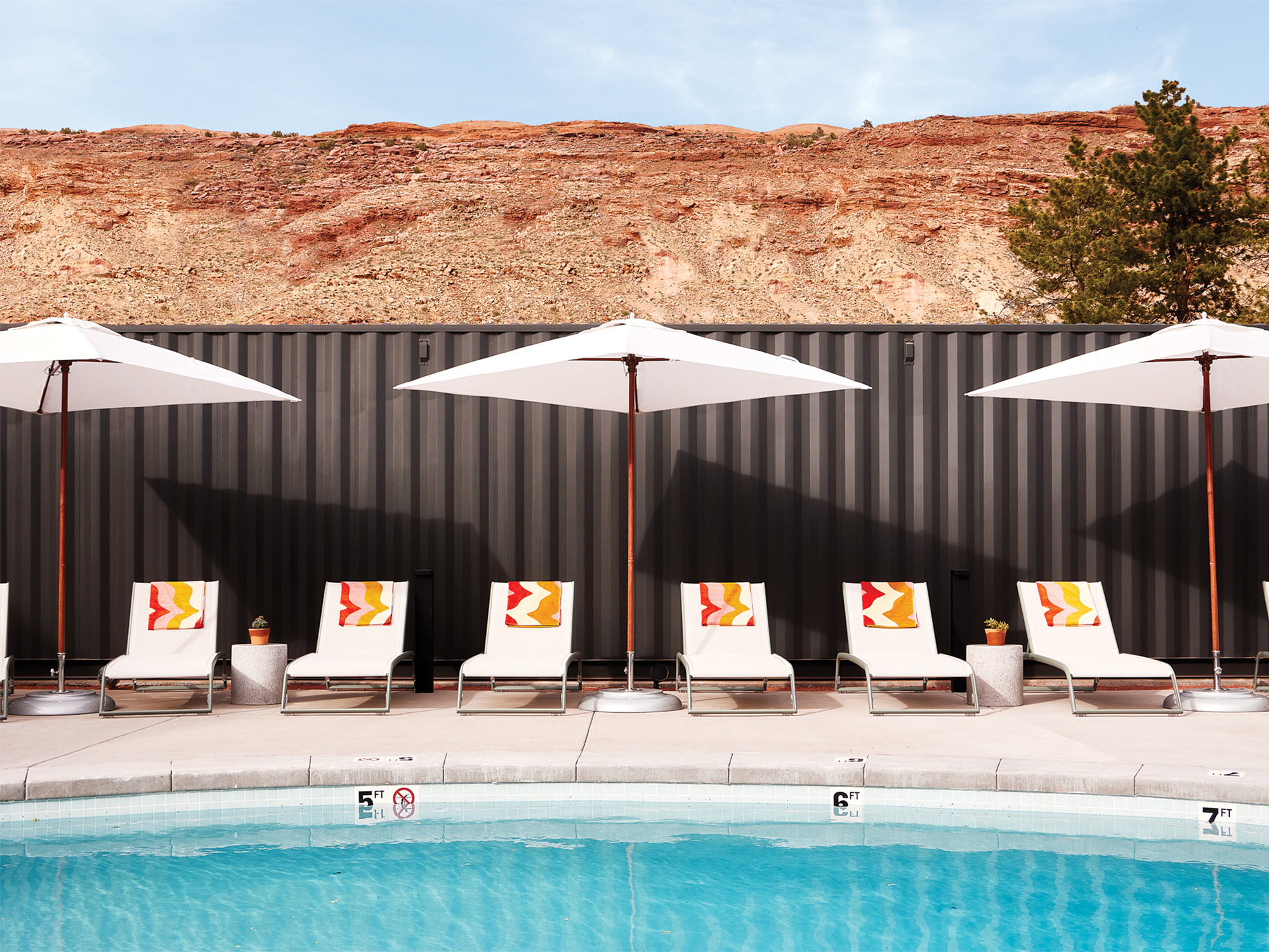
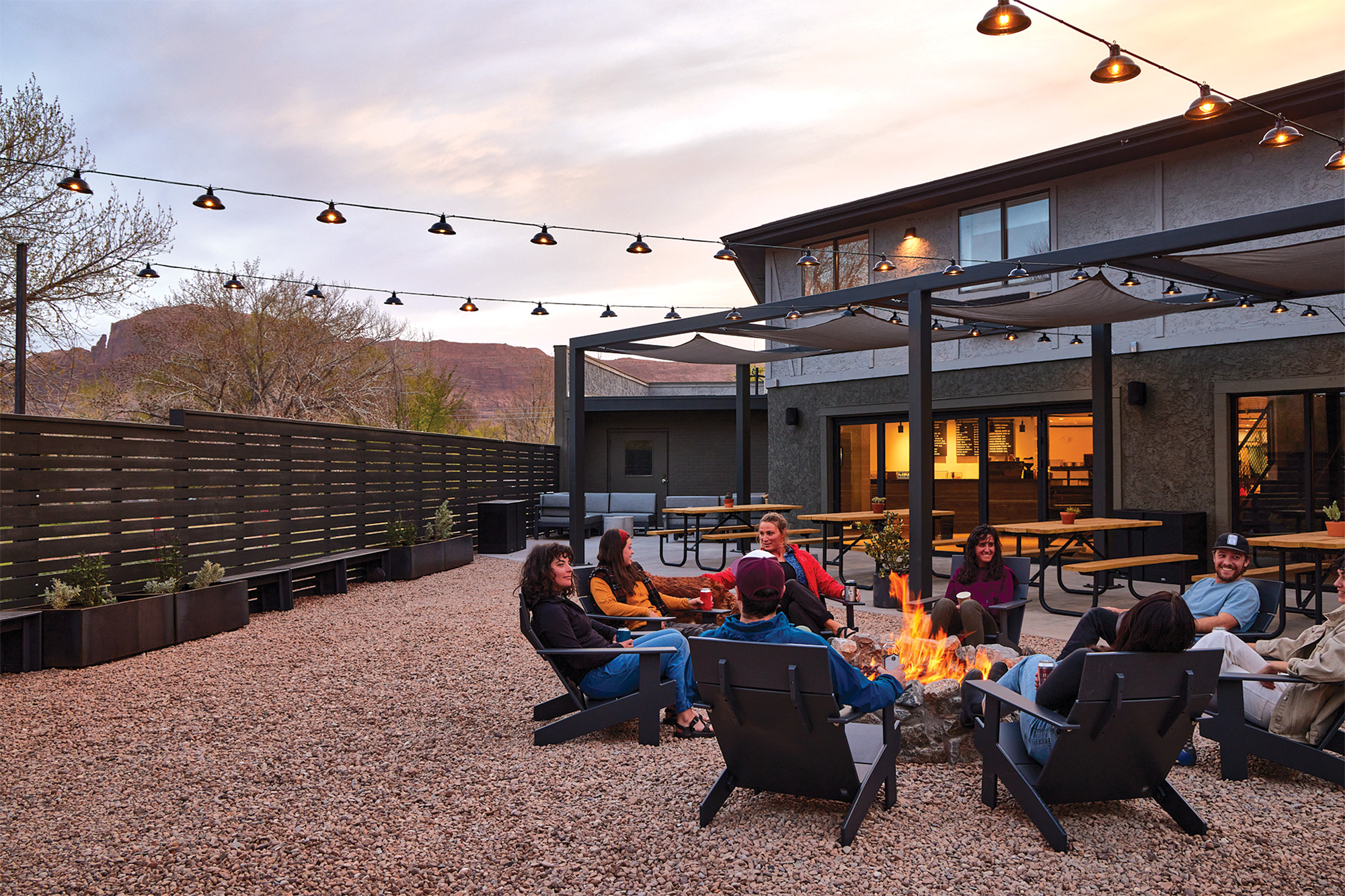
The first Field Camp soft-launched in spring 2023, located in a renovated old-school motel at the north end of Moab, near the Colorado River. (A second Field Station near Joshua Tree, California, will open in 2024.) The bones tell you it was once a Shiloh Inn or Best Western or Ramada, but the decor is all birch plywood, bright white walls, and concrete floors that don’t care about red dust and chain lube. Rooms include Dometic electric coolers. Bikes are welcome. There are rooms with king beds, two queens, king beds plus bunks. In January 2024, the cost for any one of them was [starts at] seventy-one dollars a night before taxes. Want to camp in your van? Twenty-nine bucks and you get access to a power hookup, hot showers, and the pool. At the start of every day, a staff member is available to help you (or the public) plan your adventure, which Field Station calls Mappy Mornings.
Said Davis, “We want to create an experience for somebody that walks through the front door and has never hiked a day in their life, who feels like they can go on a hike with the right knowledge, the right tools, and the right support to do so safely. Even the name Field Station came about because of the concept of education in the outdoors. We wanted to make sure that at every stage of the experience, you were able to learn something new. For people who this might be one of their first outdoor experiences, there’s a lot to learn, but even for people who have been in the outdoors for decades, there are things we wanted to teach them about local partners that were doing some really great stuff in the nonprofit space, introducing them to gear that they’ve never seen before, just giving them an opportunity to learn something new.”
Campfield: Community and Nature
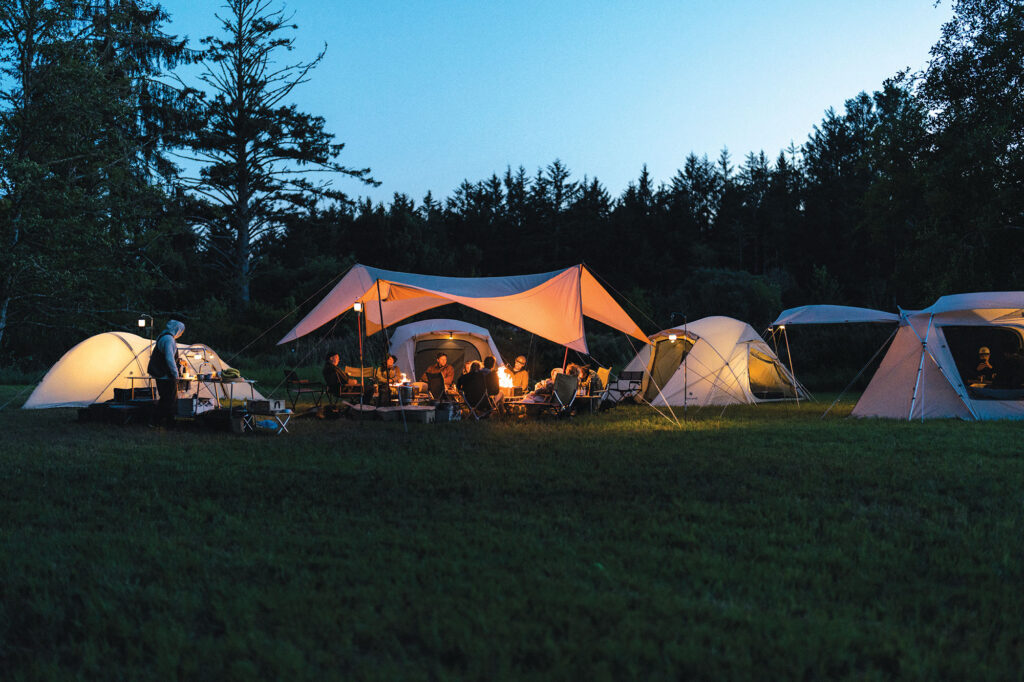
A casual outdoor person might know Snow Peak just for its titanium cookware, chopsticks, or portable firepits, but it is, as they say, huge in Japan. The company’s stock trades on the Tokyo Stock Exchange and it runs six branded Campfields across the country, including the inaugural one near its headquarters in Niigata. That first Campfield, launched in 2011, served as a testing ground for new products and became the flagship for Snow Peak’s transition away from its mountaineering and backpacking roots and toward the communal camp experience more common in Japan.
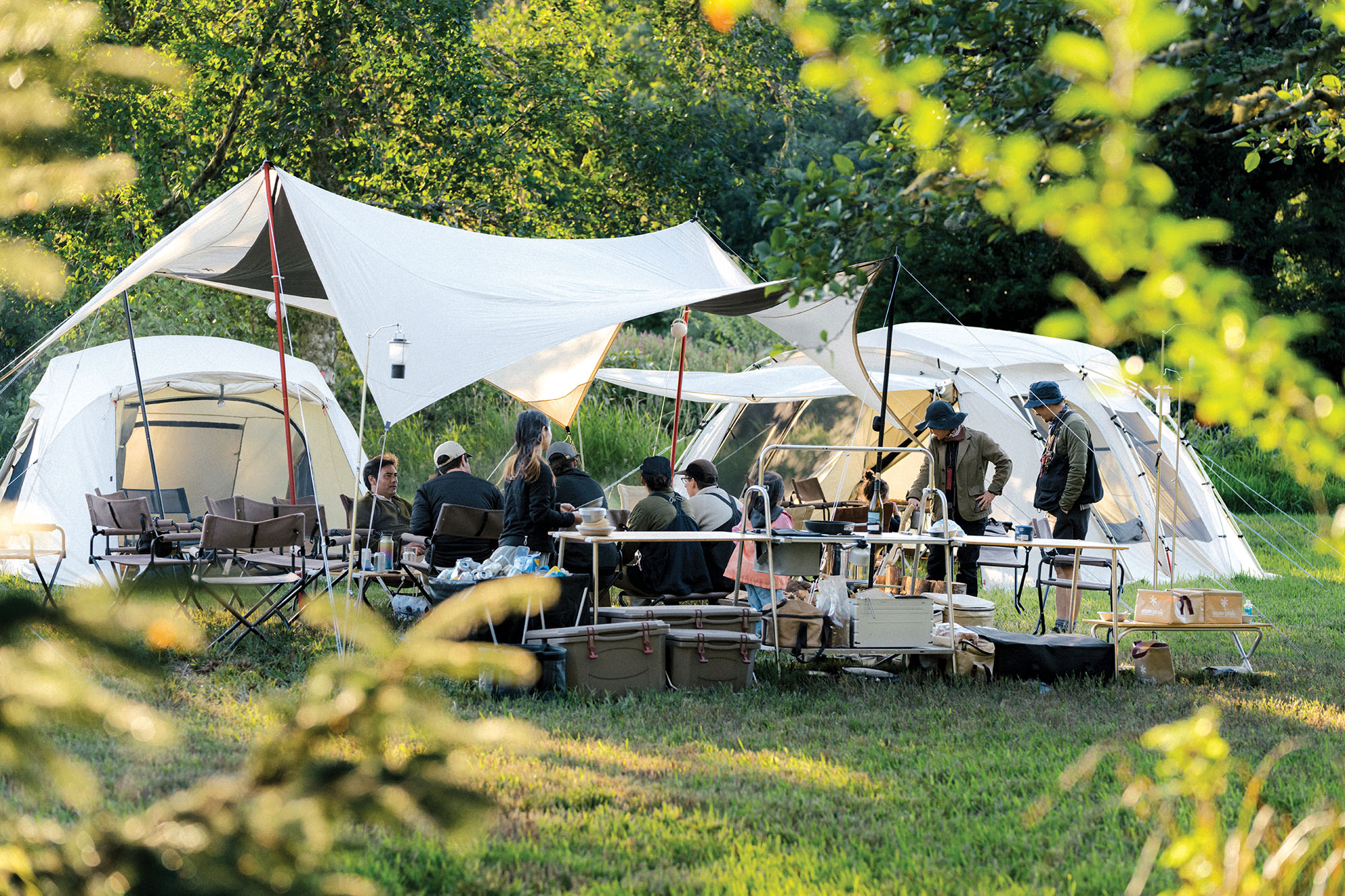
“The American approach to camping is that your campground is the base camp for lots of activities and you pitch a tent then go for a bike ride or climb or hike. And this becomes this kind of hub for other activities,” said Josh Simpson, who joined the Long Beach Campfield as general manager after years of running Sea to Summit in the States. “With Japanese-style camping, the campground is the destination. There are similarities to Australian camping and even overlanding, but the base camp becomes the destination and the activity is the campground and the camping experience. And with Campfield, that extends into cooking and time around the fire and playing games and just being with each other in nature. And that is core to the Snow Peak style.”
The Long Beach site is a former RV park located on thirty acres of woods and wetlands about a mile from the coast. “A big part of the original challenge was to remove all the structures and the impact that had been here for forty years and start to put this chunk of land back together into its natural state,” said Simpson. “So we worked with the county and a bunch of wetland specialists to reenergize the property and mitigate the impact that we were going to have on it and heal the land that was here. It will be another couple years before this property fully comes back to its natural state, but it’s a night and day difference from what it was three years ago.”

The “field” in Campfield refers to the Japanese style of camping together in, well fields. Long Beach has tent sites scattered in the woods and more in open areas. You can pitch your own tent and there are “tent suites” with Snow Peak tents already in place, and jyubako tiny cabins. Cars are left in the parking lots and your gear is carried or carted to your spot. “You’re walking away from the connected world and into this space that is designed to disconnect and then connect you into the natural environment that we’ve designed,” said Simpson.
Prices vary depending on the time of year and the day of the week. Tent sites cost about seventy-five dollars, the tent suites (which are stocked with Snow Peak gear) about two hundred, and the cabins about three hundred. All give you access to a camp store, library, wash house, and spa with a Japanese soaking pool, hot pool, cold plunge pool, and then sauna.
In November 2023, the U.S. Bureau of Commerce announced outdoor recreation contributes one trillion dollars to the economy annually and is responsible for five million jobs. American hotels book about 1.3 billion “room-nights” a year. LOGE, Field Station, and Campfield were built by people passionate about the outdoors, and more lodging operations are on the way from industry veterans (Pacific Northwest retailer Evo recently opened a hotel in Salt Lake City). But venture capital and large hospitality brands are licking their chops at the size of the market.
“There are a number of big private equity shops now trying to get into this space and they’re doing it from a boardroom in Chicago or New York because they see an opportunity,” said Genebacher. “Which is fine. But LOGE is built by doers, for doers. This isn’t like, hey, we saw a spreadsheet that said this. It was, hey, I want it to be easier for people like me to get outside and have fun.”